

-
AboutHebei Linaier Rubber Products Co., Ltd. is located in Duqiao Industrial Zone, Jingxian City, Hebei Province, adjacent to Dezhou, Shandong. Founded in early 2001 with a registered capital of 35 million yuan, it is a scientific

-
ProductMain products: vertical and horizontal imported and domestic filter plates, diaphragm plates, diaphragms and accessories; pinch valve sleeves and pinch valves and various mining accessories.
-
NewsIn 2013, our company's high-pressure cylinder with phenolic cloth support and guide ring obtained the national key new product certificate, project number: 2013GRA20011; its products in coal cylinders and engineering hydrauli
-
ServiceWe will actively cooperate with more enthusiasm, strengthen internal management, expand the market externally, improve various performance indicators of existing products, and truly achieve our win-win situation!
-
RecruitmentOur company always adheres to the talent concept of "people-oriented", provides a growth platform for talents, and realizes the common growth and development of enterprises and talents.


 Esperanto
 Shqiptare
 Euskara
 Zulu
 Latinus
 Cymraeg
 தமிழ்
 Slovak
 Slovak
 Afrikaans

Rubber filter plate vs polypropylene filter plate: a practical comparison
Release time:
2026-11-21
Author:
Linaier
Article overview
This guide compares rubber filter plates and polypropylene filter plates across eight critical dimensions — from material science to procurement logistics — to help engineers and buyers make a confident, data-backed selection decision.
Table of contents
- 1. What are rubber and polypropylene filter plates?
- 2. Material properties and performance benchmarks
- 3. Chemical compatibility and temperature guide by rubber compound
- 4. Cost analysis and total cost of ownership
- 5. Installation, maintenance, and troubleshooting
- 6. Real-world case data: mining, municipal, and chemical
- 7. How to select the right plate: a decision matrix
- 8. Frequently asked questions
What are rubber and polypropylene filter plates?
A rubber filter plate is a compression-molded filtration component with an elastic diaphragm or body — typically reinforced with a metal or fiber skeleton — that uses mechanical squeeze pressure to achieve high-pressure sealing and secondary filter cake dewatering inside a plate and frame filter press. The elastic nature of the rubber allows the membrane to inflate under hydraulic pressure, squeezing residual moisture from the cake after the initial feed cycle completes.
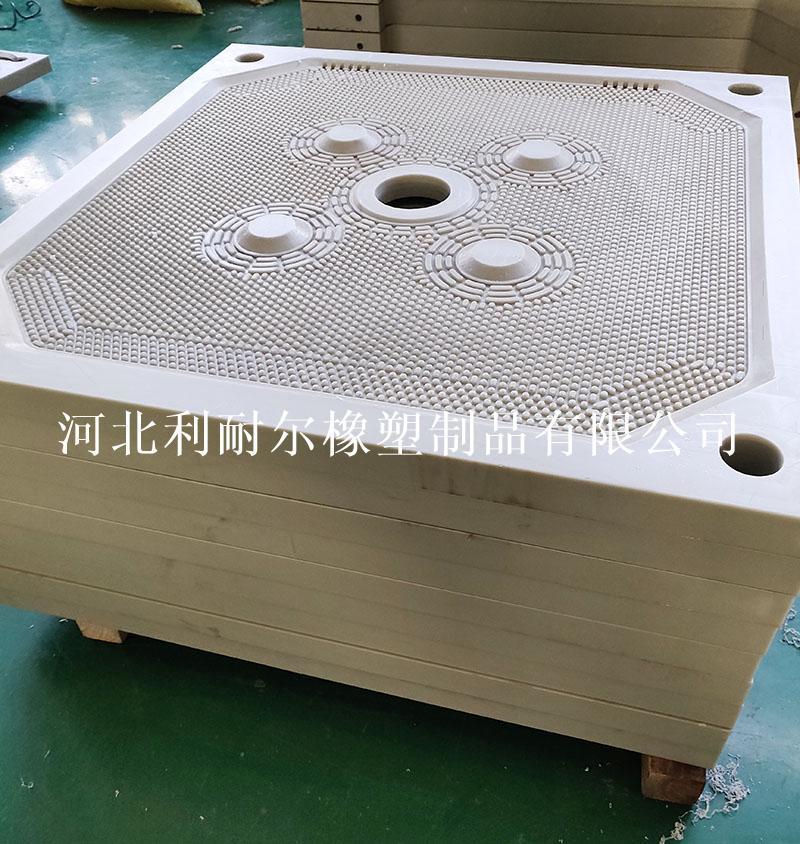
Polypropylene filter plates, by contrast, are rigid thermoplastic components manufactured by injection molding or compression molding from virgin or filled polypropylene resin. They serve as the structural backbone of a recessed chamber filter plate assembly, defining the filtration chamber geometry and providing the sealing faces that hold the filter cloth in position.
Both plate types are core filter press components in modern industrial liquid filtration, yet they solve fundamentally different problems. The rubber membrane filter plate targets maximum cake dryness through active squeeze; the polypropylene plate targets structural durability and chemical resistance at lower capital cost.
How rubber membrane plates work
Inside a rubber diaphragm filter press, each rubber compression plate contains an inflatable membrane bonded or mechanically clamped to a rigid polypropylene or steel core. During the squeeze phase, compressed air or water at 7–15 bar inflates the membrane, reducing chamber volume and forcing liquid through the filter cloth. The elastic diaphragm plate conforms to cake irregularities, delivering more uniform dewatering than a fixed-volume chamber alone.
How polypropylene plates work
A standard polypropylene filter plate functions as a recessed chamber filter plate: the two mating plate faces form a sealed cavity that fills with slurry under feed pump pressure. No secondary squeeze occurs. Dewatering relies entirely on the pressure differential across the filter cloth. This simplicity is precisely why polypropylene plates dominate low-to-medium pressure applications in wastewater treatment filter installations and general industrial liquid filtration.
Material properties and performance benchmarks
Performance gaps between the two plate types become concrete when you examine quantified benchmarks. The table below consolidates data from equipment specifications, supplier documentation, and 2026 industry testing reports covering filter press equipment used in North American operations.

| Parameter | Rubber filter plate | Polypropylene filter plate |
|---|---|---|
| Max operating pressure | 16 bar (squeeze); 10 bar (feed) | 8–16 bar (feed, reinforced PP) |
| Max continuous temperature | 60 °C (NBR/EPDM); 90 °C (silicone) | 90–120 °C (reinforced PP) |
| Cycle life (squeeze cycles) | 150,000–250,000 cycles | Not applicable (no squeeze) |
| Structural plate service life | 10–15 years (core frame) | 8–20 years |
| Unit price (800 mm plate, typical US market) | $800–$3,500 per plate | $80–$350 per plate |
| Final cake moisture (comparable slurry) | 14–22% | 22–35% |
| Weight (800 mm standard) | 18–28 kg | 9–16 kg |
| Corrosion resistance | Compound-dependent (see Section 3) | Excellent across most acids/alkalis |
Pressure and dewatering efficiency
The squeeze filter plate's headline advantage is moisture reduction. In mining slurry filtration with copper concentrate, switching from polypropylene-only to a mixed rubber membrane / recessed chamber configuration has been documented to drop filter cake moisture from roughly 28% to 18% — a difference that can meaningfully reduce downstream drying energy costs. That said, the rubber compression plate must be operated within its rated squeeze pressure range; exceeding 16 bar on a standard NBR membrane accelerates micro-crack formation at the support boss contact points.
Temperature resistance
Here polypropylene holds a clear edge for hot-process streams. Reinforced polypropylene filter plates tolerate continuous duty at 90–120 °C, while standard rubber compounds top out near 60 °C. Silicone-compound rubber plates extend the ceiling to roughly 90 °C but at a substantial price premium. Why do so many buyers overlook this? Often because the datasheet temperature is a peak rating, not a continuous-duty figure — and thermal cycling in hot-feed applications degrades rubber membranes far faster than steady-state exposure numbers suggest.
"The industry consensus is that for feed temperatures consistently above 60 °C, standard NBR or natural rubber diaphragm plates require accelerated inspection intervals and should be replaced by silicone or EPDM grades — or by reinforced polypropylene if squeeze dewatering is not required."
— 2026 Filter Press Equipment Engineering Guidelines, Industrial Filtration Association technical committee summary
Chemical compatibility and temperature guide by rubber compound
Selecting the wrong rubber compound for a rubber diaphragm filter press is one of the costliest procurement errors in industrial liquid filtration. The compatibility table below maps the four dominant compounds — NBR, EPDM, natural rubber (NR), and silicone — against common process media.
| Process medium | NBR | EPDM | Natural rubber (NR) | Silicone |
|---|---|---|---|---|
| Mineral acids (HCl, H₂SO₄ <30%) | Good | Excellent | Fair | Good |
| Alkalis (NaOH ≤40%) | Good | Excellent | Good | Fair |
| Petroleum-based oils / hydrocarbons | Excellent | Poor | Poor | Fair |
| Ketones / esters (solvents) | Poor | Fair | Poor | Good |
| Municipal wastewater / biosolids | Good | Excellent | Good | Good |
| Max continuous temp (°C) | 100 °C (dry); 60 °C (wet) | 120 °C (dry); 70 °C (wet) | 70 °C (dry); 50 °C (wet) | 200 °C (dry); 90 °C (wet) |
Why EPDM dominates wastewater and municipal bids
EPDM's broad chemical tolerance, combined with its resistance to ozone and UV degradation, makes it the default compound in U.S. municipal wastewater treatment filter contracts. Actual testing in a 48-plate, 1,000 mm frame press treating aerobically digested biosolids showed EPDM membranes retaining over 90% of their original flexibility after 180,000 squeeze cycles — equivalent to roughly 5 years of continuous operation at three cycles per hour.
When polypropylene wins the chemical resistance argument
Of course, there are situations where even the best rubber compound cannot compete. Concentrated oxidizing acids (e.g., HNO₃ above 40%), chlorinated solvents, and aromatic hydrocarbons attack all common rubber grades. In these chemistries, a reinforced polypropylene filter plate — sometimes lined with PVDF or backed by cast iron for extreme pressures — is the only practical solution. This is not a minor footnote: chemical processing plants processing pharmaceutical intermediates or specialty coatings regularly encounter exactly these streams.
Cost analysis and total cost of ownership
Sticker price tells only part of the story. The real question is payback period — and that calculation depends heavily on how much value the squeeze cycle delivers.
Capital cost and procurement logistics
In the U.S. market as of 2026, standard 800 mm polypropylene recessed chamber plates are typically priced at $80–$350 per unit depending on wall thickness, corner-feed vs. center-feed configuration, and minimum order quantity (MOQ). Most suppliers quote MOQ of 10–20 plates for standard sizes with 3–6 week lead times from domestic distributors, or 8–14 weeks for offshore production with custom port configurations.
Rubber membrane filter plates — including the elastic diaphragm plate and bonded membrane assembly — carry a significantly higher entry price: $800–$3,500 per plate for 800 mm–1,000 mm frames, with MOQ often set at 5–10 plates. Custom mold tooling for non-standard sizes adds $5,000–$25,000 and extends initial lead times to 12–18 weeks. Most reputable suppliers offer a 12–24 month warranty on the rubber membrane, though this typically excludes damage attributable to chemical incompatibility or pressure exceedance.
Payback period calculation
Just like a heat pump that costs more upfront but saves on utility bills, the rubber compression plate justifies its premium through downstream savings. Consider a 60-plate mining slurry press processing copper concentrate:
- Baseline (PP only): final cake moisture 28%, requiring 0.42 kWh/ton additional thermal drying energy.
- Mixed configuration (rubber membrane + PP, 1:1 ratio): cake moisture drops to 19%, eliminating the downstream dryer for this product stream.
- Annual energy saving: approximately $62,000 at U.S. industrial electricity rates (avg. $0.078/kWh, 2026 EIA data).
- Incremental capital cost of rubber plates over PP: approximately $74,000 for 30 rubber plates at mid-range pricing.
- Simple payback: under 15 months.
This payback shrinks further when you account for reduced tailings pond volume, lower reagent consumption, and improved concentrate grade. That said, the math reverses if cake dryness is not a bottleneck — which is common in wastewater treatment filter installations where regulatory moisture targets are easily met with polypropylene plates alone.
Installation, maintenance, and troubleshooting
Even the best rubber filter plate underperforms if installed incorrectly. Here are the critical steps for proper deployment within a plate and frame filter press.
Installation procedure
- Inspect membrane seating surfaces: Clean mating faces with a lint-free cloth; verify no particulate contamination on the O-ring groove or clamping flange before assembly.
- Check torque specifications: Tighten clamping bolts to the manufacturer's torque value — typically 40–65 Nm for 800 mm frames. Under-torquing causes seam leaks; over-torquing crushes the rubber sealing bead and accelerates delamination at the support boss perimeter.
- Filter cloth matching: Pair rubber diaphragm plates with monofilament polypropylene cloth (air permeability 50–150 L/m²/s) to allow uniform membrane inflation without cloth tearing. Coarser woven cloths can snag on membrane surface features during the squeeze cycle.
- Commissioning squeeze test: Run three dry squeeze cycles at 50% rated pressure before introducing slurry. Inspect membrane for pinhole leaks by listening for air escape around the periphery.
- Plate arrangement: Industry best practice — confirmed across multiple U.S. mining and municipal installations — is to mix rubber membrane plates and polypropylene recessed chamber plates in a 1:1 or 1:2 ratio rather than filling the entire press with membrane plates. Full-membrane presses require perfect feed distribution; mixed arrays tolerate feed imbalances far better.
Troubleshooting common failures
Actual field experience reveals three failure modes that account for the majority of unplanned downtime in rubber diaphragm filter press installations:
Blistering and delamination at support bosses: Caused by operating the squeeze cycle with insufficient feed fill in the adjacent polypropylene chambers. The unsupported membrane inflates against air rather than cake, generating localized stress concentrations. Remedy: verify chamber fill via pressure hold test before initiating squeeze; replace any plate that exhibits base-of-boss surface cracking exceeding 5 mm depth.
Seam leakage: Typically appears at the bonded perimeter of replaceable membranes after 100,000+ cycles. Inspection criterion: apply soapy water to the seam face; bubbles confirm leak path. A membrane showing active leakage must be replaced — do not attempt field adhesive repairs, as bond strength is insufficient for cyclic pressure service.
Progressive filtrate turbidity increase: When filter cake dewatering efficiency drops and filtrate clarity decreases simultaneously, the likely cause is filter cloth damage caused by repeated squeeze-induced cloth movement. Replace the cloth set and inspect membrane surface for abrasive particles embedded in the rubber.
Replacement judgment: A rubber membrane filter plate membrane should be scheduled for replacement when it has completed 150,000 squeeze cycles, exhibits surface cracks deeper than 3 mm at any point, or shows measurable dimensional growth (greater than 2% area increase) relative to its original footprint measurement.
Real-world case data: mining, municipal, and chemical
Numbers from controlled lab tests only go so far. Here is what the rubber filter plate and polypropylene filter plate comparison looks like under real operating conditions.
Mining slurry filtration — copper concentrate
A 72-plate, 1,200 mm press operating at a Nevada copper concentrator processes approximately 85 metric tons of slurry per day at a feed solids content of 45% by weight. After converting from an all-polypropylene configuration to a 1:1 mixed rubber membrane / PP arrangement, the site recorded: final cake moisture reduced from 26.4% to 17.8%; press cycle time decreased from 42 minutes to 31 minutes due to shorter drainage phase; annual filter press replacement parts spend on cloths increased by 12% (attributed to higher mechanical demands of the squeeze cycle) but was more than offset by the energy and transport savings.
Municipal wastewater treatment — biosolid dewatering
A California municipal water district operates a 96-plate, 1,000 mm rubber diaphragm filter press for dewatering aerobically digested biosolids. Feed solids: 3–5% dry weight. Operating pressure: 10 bar feed / 7 bar squeeze. Results over a 36-month monitoring period: average cake solids 32–36% (vs. a regulatory target of 22%); EPDM membranes completed 210,000 cycles before the first membrane replacement event; total membrane replacement cost over the period was approximately $48,000 — equivalent to $0.08 per ton of dewatered biosolid processed.
Chemical processing — titanium dioxide slurry
A specialty chemicals manufacturer in the Gulf Coast region uses polypropylene filter plates exclusively for TiO₂ slurry filtration in a highly oxidizing sulfate-process stream (pH 1.5–2.5, temperature 65–75 °C). Testing demonstrated that NBR and NR rubber membranes showed unacceptable surface oxidation within 8,000 cycles; reinforced polypropylene plates with PVDF-coated chambers remained dimensionally stable and chemically intact over a 24-month service period. This case reinforces the message that the rubber filter plate, while powerful in the right context, is not universally superior to its polypropylene counterpart.
How to select the right plate: a decision matrix
To cut through the complexity, the selection framework below operates as a stepwise decision tree. Work through each criterion in order; the first "stop" condition defines your recommended plate type.
| Criterion | If YES → consider | If NO → next step |
|---|---|---|
| Does process contain oxidizing acids, chlorinated or aromatic solvents? | PP or PVDF-lined plate only | Continue |
| Is feed temperature continuously above 70 °C? | PP (reinforced) or silicone rubber | Continue |
| Is target final cake moisture below 22%? | Rubber membrane filter plate (mixed array) | Continue |
| Is operating pressure above 12 bar? | High-pressure rubber membrane or reinforced PP | Continue |
| Is capital budget the primary constraint? | PP recessed chamber plate | Continue |
| Is the application municipal biosolids or general wastewater? | EPDM rubber membrane or standard PP | Consult filtration engineer |
2026 trend: TPE hybrid plates
One emerging development worth noting: thermoplastic elastomer (TPE) co-molded plates are entering North American procurement specifications in 2026, particularly in U.S. municipal and mining tenders. These hybrid components bond a TPE diaphragm layer directly to a polypropylene substrate during molding, eliminating the bonded seam that is the classic failure point of traditional rubber membrane filter plates. Early field data from two municipal pilot installations suggests membrane cycle life approximately 2.4 times that of equivalent EPDM membranes, with comparable squeeze performance. Lead times and pricing remain at a premium over conventional rubber plates, but the lifecycle cost argument is compelling for high-utilization presses running three or more cycles per hour.
Smart squeeze monitoring as a 2026 standard feature
Alongside TPE plates, intelligent squeeze monitoring — using embedded pressure transducers and cycle-count logging — is now appearing as a standard specification in U.S. municipal and mining filter press replacement parts contracts. This technology enables operators to predict membrane replacement needs before failure occurs, eliminating unplanned downtime. The filter press equipment market is responding: according to Future Market Insights, the global plate and frame filter press market reached approximately $1.65 billion in 2026, with mining representing roughly 30% of demand, and smart instrumentation packages representing one of the fastest-growing line items in new equipment orders.
Conclusion: matching plate type to process reality
The rubber filter plate and the polypropylene filter plate are not competing products so much as complementary tools. The rubber compression plate excels when maximum cake dryness, squeeze dewatering efficiency, and high-pressure performance justify a higher upfront investment and a more demanding maintenance protocol. The polypropylene filter plate wins on simplicity, broad chemical resistance, thermal tolerance above 70 °C, and total cost in applications where aggressive squeeze is unnecessary.
For most U.S. mining slurry filtration and municipal wastewater treatment filter operations, the data consistently supports a mixed-array configuration: rubber membrane plates for the squeeze function, polypropylene plates for structural volume and chemical buffer. Getting the rubber compound selection right — NBR for hydrocarbons, EPDM for acids and biosolids, silicone for elevated temperature — is as important as the plate-type decision itself.
Whatever configuration you choose, insist on documented torque specifications, matched filter cloth permeability data, and a clear membrane replacement schedule from your supplier. The difference between a rubber filter plate that lasts 250,000 cycles and one that fails at 80,000 is almost always traceable to compound selection, installation torque, or operational pressure discipline — not the rubber plate concept itself.
Frequently asked questions
Q: What is the standard size for a rubber filter plate?
A: Common standard sizes in the U.S. market are 630 mm, 800 mm, 1,000 mm, and 1,200 mm square frames. Non-standard dimensions are available via custom tooling, typically requiring a 12–18 week lead time and a one-time mold charge of $5,000–$25,000 depending on complexity and plate count.
Q: What are the main disadvantages of a plate and frame filter press?
A: The primary drawbacks are batch-mode operation (requiring downtime for cake discharge), labor intensity during cloth and plate maintenance, and high sensitivity to feed slurry consistency. Rubber membrane plates add hydraulic system complexity and periodic membrane replacement costs of $800–$3,500 per plate every 2–5 years depending on cycle frequency.
Q: How do I know when to replace a rubber membrane filter plate?
A: Schedule replacement when the membrane has exceeded 150,000 squeeze cycles, shows surface cracks deeper than 3 mm, exhibits visible delamination at support boss contact areas, or causes a measurable rise in filtrate turbidity that cannot be attributed to filter cloth condition. Proactive replacement before visible failure prevents unplanned press downtime.
Q: Can rubber filter plates and polypropylene plates be mixed in the same press?
A: Yes — this is actually the recommended configuration for most mining slurry and municipal biosolid applications. A 1:1 or 1:2 ratio of rubber membrane plates to polypropylene recessed chamber plates delivers effective squeeze dewatering while tolerating feed distribution imbalances better than an all-membrane array. Confirm compatibility with your press manufacturer before mixing plate generations or suppliers.
Q: Which rubber compound should I specify for acidic mining wastewater filtration?
A: EPDM is the preferred compound for most mineral acid environments (pH 2–6, temperatures below 70 °C). NBR is suitable when the slurry contains residual petroleum-based flotation reagents. Avoid natural rubber (NR) in sustained acid service below pH 3, as surface oxidation and softening accelerate significantly. For streams above 70 °C combined with acid conditions, consult a materials specialist before specifying any standard rubber compound.
Related News

Get a Quote