

-
AboutHebei Linaier Rubber Products Co., Ltd. is located in Duqiao Industrial Zone, Jingxian City, Hebei Province, adjacent to Dezhou, Shandong. Founded in early 2001 with a registered capital of 35 million yuan, it is a scientific

-
ProductMain products: vertical and horizontal imported and domestic filter plates, diaphragm plates, diaphragms and accessories; pinch valve sleeves and pinch valves and various mining accessories.
-
NewsIn 2013, our company's high-pressure cylinder with phenolic cloth support and guide ring obtained the national key new product certificate, project number: 2013GRA20011; its products in coal cylinders and engineering hydrauli
-
ServiceWe will actively cooperate with more enthusiasm, strengthen internal management, expand the market externally, improve various performance indicators of existing products, and truly achieve our win-win situation!
-
RecruitmentOur company always adheres to the talent concept of "people-oriented", provides a growth platform for talents, and realizes the common growth and development of enterprises and talents.


 Esperanto
 Shqiptare
 Euskara
 Zulu
 Latinus
 Cymraeg
 தமிழ்
 Slovak
 Slovak
 Afrikaans

What is a pinch valve? Types, working principles, and applications explained
Release time:
2026-11-11
Author:
Linaier
Article overview
A pinch valve is a linear-motion valve that stops or throttles flow by squeezing a flexible elastomer sleeve closed, keeping the process media isolated from every metal part of the valve body. If you handle slurry, grit, fibers, or corrosive liquids, this guide explains what a pinch valve is, how the sleeve mechanism works, which types exist, and where each one fits in 2026 process plants. It is written for plant engineers and buyers in the United States, and it ends with selection parameters, sleeve replacement steps, and a practical comparison with other valve styles.
Table of contents
What is a pinch valve and what are its main components?
A pinch valve is a flexible-sleeve shutoff and control valve that closes by squeezing an elastomer tube until its bore collapses. Nothing else touches the process fluid, which is why this style has such a loyal following in dirty services.
A pinch valve is a valve in which a flexible sleeve is compressed, either by pinching bars or by external air or liquid pressure, until the flow path is sealed. The principle is documented in general references, including the pinch valve overview on Wikipedia, and it has served industrial piping for decades. Think of pressing on a garden hose: pressure from the outside, not a gate on the inside, stops the water.
Core components of a pinch valve
A typical pinch valve has only a few parts, and that simplicity is a large part of its appeal.
- Sleeve (liner): the elastomer tube that forms both the flow path and the seal.
- Body or frame: an open frame or a closed housing that supports the sleeve and the end connections.
- Pinching mechanism: mechanical pinch bars, a pressurized air chamber, or a liquid-filled chamber.
- Actuator: a handwheel, pneumatic cylinder, electric motor, or pilot air supply.
- End connections: flanged, wafer-style, threaded, or sanitary clamp ends, depending on the service.
Because the sleeve is the only wetted component, the rest of the assembly can often be built from standard carbon steel, aluminum, or stainless steel without exotic alloys. That is a real cost advantage when the media would otherwise chew through a lined metal valve. In plant walk-downs, maintenance crews frequently point out that a pinch valve has no packing gland to leak, which removes a common housekeeping complaint.
Why does the elastomer sleeve decide performance?
Sleeve quality sets service life, pressure rating, and chemical compatibility more than any other factor. A rubber pinch valve sleeve is usually built from an inner liner, fabric or cord reinforcement, and an outer cover, then molded and vulcanized as one piece. Compound choice matters. Natural rubber is a long-standing option for abrasive slurries, EPDM suits many water and mild chemical duties, nitrile handles oils, and silicone or fluoroelastomer serve narrower sanitary or chemical niches. Hardness, ply count, and cure consistency all influence how many cycles the sleeve survives. Why do two valves with identical dimensions wear so differently? Usually the compound and the molding quality explain it. An elastomer sleeve valve is only as good as the rubber inside it.
Strengths and limits to keep in mind
No valve is universal. The strengths of a flexible sleeve valve are full-bore flow with low pressure drop, no dead pockets where solids settle, tolerance for abrasive and fibrous media, and simple field service. The limits are elastomer temperature ceilings, pressure ratings that are moderate compared with metal-seated valves, a finite sleeve life measured in cycles, and non-linear throttling near the ends of travel. Always confirm these limits against the manufacturer's datasheet rather than generic figures.
How does a pinch valve work?
A pinch valve works by moving a pinching element against a flexible sleeve, which flattens the tube and blocks flow. Releasing the force lets the sleeve's own elasticity restore the open bore. The action is mechanical, direct, and easy to visualize.
Step-by-step operating sequence
- Media flows through the open sleeve along a straight, unobstructed full-bore path.
- The actuator receives a close command: a turned handwheel, air to a cylinder, or an electric signal.
- Pinch bars move together, or control pressure builds around the sleeve inside a sealed body, pushing the walls toward the centerline.
- The sleeve walls meet and seal. Solids are displaced rather than trapped against a seat.
- On the open command, the force is removed and the reinforced elastomer rebounds to its round shape.
In an air-pinched design, line pressure and control pressure interact, so the control supply must exceed line pressure by a margin the manufacturer specifies. Skipping that check is a classic commissioning error.
Manual, pneumatic, and electric actuation
Actuation determines speed, automation level, and failure behavior. A manual pinch valve uses a handwheel and screw to drive the pinch bars, which suits low-cycle isolation and remote spots without utilities. An air operated pinch valve uses compressed air, either through a cylinder on an open frame or directly on the sleeve inside a closed body. A pneumatic pinch valve is the usual choice for fast, repeatable cycling in batching, filter press feed, and discharge lines. An electric actuated pinch valve uses a motor and gearbox. It fits sites without clean instrument air and lets operators position the valve for modulating control. Spring-return pneumatic actuators add fail-open or fail-closed behavior, which safety reviews often require.

Can a pinch valve throttle flow?
Yes, within limits. A pinch valve gives usable modulating control in the middle of its stroke, but the flow characteristic is non-linear and the final portion of closure changes flow sharply. Many engineers add a positioner and avoid holding the valve nearly closed for long periods, because partial pinching concentrates wear on a small zone of the sleeve. In slurry service, a throttled pinch valve is still gentler than a partly open metal-seated valve, where high velocity across the seat erodes trim quickly. Use the manufacturer's sizing data, because published Cv values vary by design and sleeve compound.
How do closing speed and pressure affect the valve?
Closing speed matters more than most specifications admit. Snap-closing a long slurry line creates a pressure spike that can exceed the pump's normal head, and the sleeve, pipe supports, and gaskets absorb that shock. A speed-control valve on the air line slows the stroke at low cost. On a mechanical design, high upstream pressure tries to push the sleeve open, so the actuator must overcome it. On an air-pinch body, the control pressure must stay comfortably above line pressure. A sleeve held closed against dried solids may also stick lightly, so some operators add a short cycling routine on idle lines.
Types of pinch valves
Pinch valves are classified mainly by body construction, actuation method, and service duty. The most common groupings are open frame, enclosed air-pinch body, and sanitary designs.
Open frame versus enclosed body designs
An open frame pinch valve exposes the sleeve between two end flanges and uses mechanical pinch bars or a pneumatic cylinder to compress it. Visual inspection is easy, and operators see wear or leakage immediately. Open frames suit dusty, wet, or abrasive areas where quick sleeve changes matter, though guards are needed to protect personnel from moving parts. An enclosed or air-pinch design places the sleeve in a sealed housing. Control air or liquid fills the space around the sleeve and squeezes it uniformly around its circumference. That even closure can reduce localized wear. The housing, however, hides the sleeve, so inspection relies on pressure-loss checks or periodic disassembly.
Both styles can be supplied as a full port pinch valve, meaning the sleeve bore matches the pipe bore so solids and fibrous strands pass without restriction. Reduced-port variants exist for tighter control, but full port remains the norm in slurry and sludge lines.
Types by actuation and service
The table below summarizes the main configurations. Entries are qualitative engineering characteristics, so confirm exact limits with each datasheet.
| Type | Actuation | Typical duty | Key limitation |
|---|---|---|---|
| Manual pinch valve | Handwheel and screw | Isolation, low-cycle, remote sites | Slow; not suited to automation |
| Air operated pinch valve (open frame) | Pneumatic cylinder on pinch bars | Frequent on/off in slurry and powders | Needs clean compressed air |
| Pneumatic pinch valve (air-pinch body) | Air or fluid pressure around sleeve | Cycling and throttling with even wear | Control pressure must exceed line pressure |
| Electric actuated pinch valve | Motor and gearbox | Sites without instrument air; modulating | Slower stroke; higher actuator cost |
| Sanitary pinch valve | Pneumatic or manual | Food, beverage, pharmaceutical | Compound and temperature limits |
Notice that the labels overlap. One valve can be both a rubber pinch valve and an air operated pinch valve, so specify body style, actuation, and sleeve compound separately on every purchase order.
What makes a sanitary pinch valve different?
A sanitary pinch valve uses food-grade or pharmaceutical-grade elastomers, a smooth bore, and clamp-style end connections so the line can be cleaned in place, or steamed where the compound allows. Materials should be documented against the rules that apply to your plant, such as FDA food-contact requirements in the United States. Request material declarations rather than assuming compliance. The lack of crevices around a seat is the main hygiene benefit, since product has fewer places to lodge. A heavy-duty slurry pinch valve goes the opposite direction, with thicker walls, abrasion-resistant natural rubber, and a rugged frame.
Pinch valve applications
Pinch valves are used wherever the media is abrasive, viscous, fibrous, corrosive, or prone to settling, and where reliable shutoff with simple maintenance is valued. Typical sectors include mining, wastewater, chemical processing, food, and dewatering.
Does a pinch valve work for abrasive slurry?
Yes, and abrasive service is where the design earns its reputation. A slurry pinch valve lets particles pass through a straight rubber-lined bore, and the flexible wall absorbs impact rather than being cut by it. Compared with conventional metal-seated valves, an abrasive media flow control valve built around an elastomer sleeve avoids a hard seat that sand, ash, or ore tailings would score. In mineral processing, cement, and ash handling, maintenance teams often report that replacing a sleeve is quicker and cheaper than rebuilding a worn metal valve. Of course, very sharp or oversized particles can still cut a sleeve, and wear is never zero. It simply moves to a part that is designed to be replaced.
Is a pinch valve suitable for wastewater?
Generally yes. A pinch valve for wastewater handles raw sludge, grit, and fibrous rags that tend to jam gates and wedge into seats. The sleeve closes around trapped solids, and the smooth bore avoids snag points. Common uses include sludge feed and transfer, polymer and lime dosing lines, grit removal outlets, and sampling points. Choose EPDM or natural rubber depending on exposure, and check chlorine or ozone compatibility explicitly, because oxidizers attack many elastomers. Fats, oils, and hydrocarbons call for a nitrile or similarly oil-resistant compound.
Filter press and dewatering lines
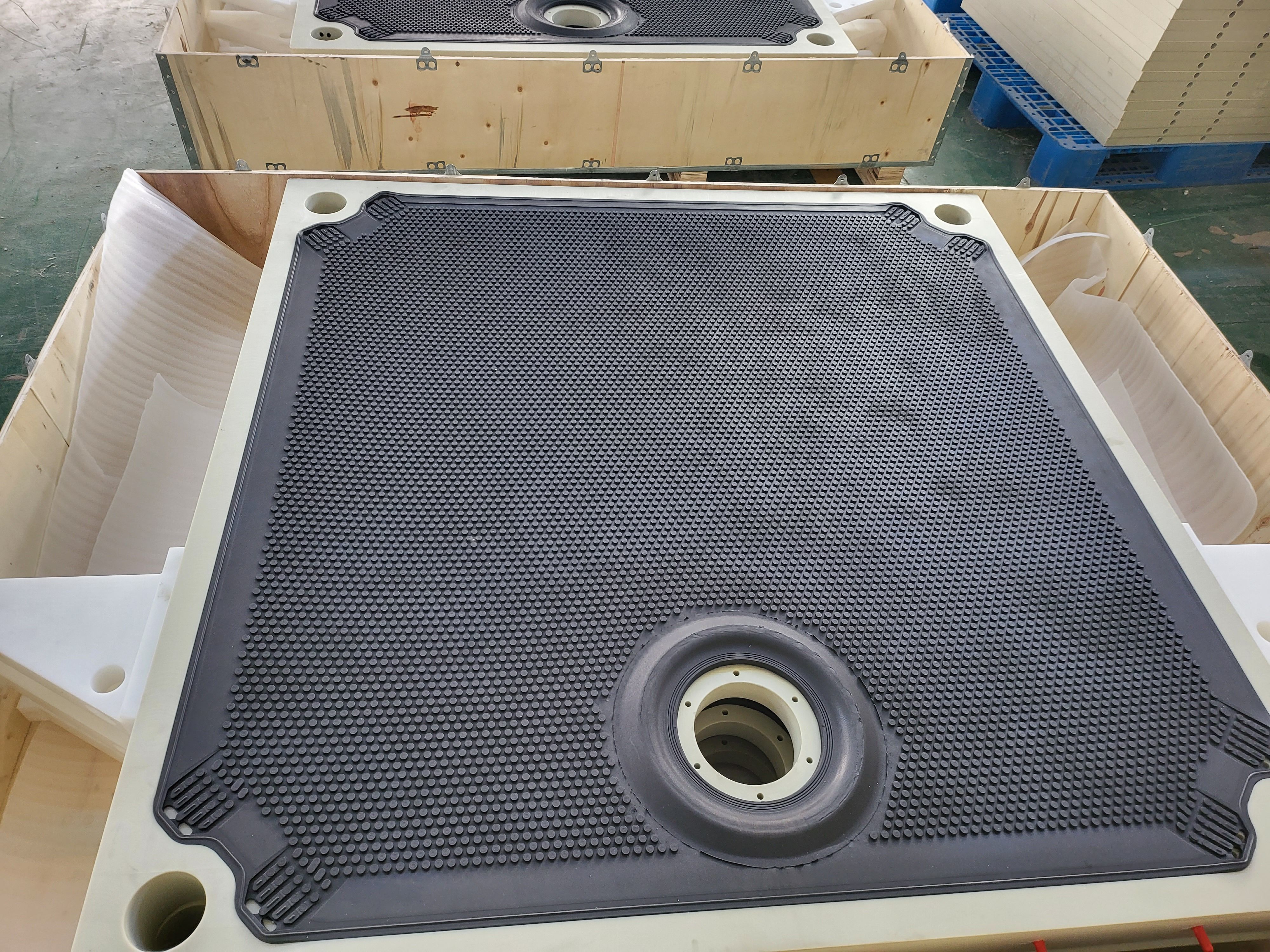
Dewatering skids cycle often and carry solids-laden feed, which makes them a natural fit for a pneumatic pinch valve. On filter press feed, cake discharge, and filtrate or blowdown lines, the valve must open and close repeatedly without sticking on dried solids. Rubber parts elsewhere in the press, such as diaphragms and seals, face similar abrasion and cycling demands, so sleeve compound choice deserves the same attention as plate and diaphragm selection. Check the valve's pressure rating against the feed pump's peak pressure, since surge peaks exceed normal readings.
Food, beverage, and dry-solids handling
Sanitary versions control sauces, fruit pulp, brewing mash, and powder or pellet streams. In pneumatic conveying, a pinch valve can work as a diverter or isolator without crushing delicate product. Dry bulk duty needs attention to sleeve wear from dust and to static discharge in combustible powders. Consult the relevant safety standards and a qualified engineer for those cases.
Pinch valve vs diaphragm valve and other options
A pinch valve usually outperforms a diaphragm valve in thick, abrasive, or fibrous media, while a diaphragm valve generally offers finer control and higher pressure capability in clean or lightly contaminated service. The right choice depends on the media, not habit.
Pinch valve vs diaphragm valve: how do they differ?
Both isolate the process from the actuator with a soft, flexible element. A diaphragm valve presses a membrane onto a weir or seat, so the flow path bends around the weir and solids can collect there. A pinch valve keeps the path straight, so slurries and long fibers pass through. Diaphragm valves are typically easier to throttle precisely and often handle higher pressure in smaller sizes, but large diameters become costly. Pinch valves scale to big, low-pressure lines at a favorable cost. The table adds a generic knife gate valve as a third reference point.
| Characteristic | Pinch valve | Diaphragm valve | Knife gate valve |
|---|---|---|---|
| Flow path | Straight, full bore | Weir or saddle, restricted | Straight, full bore |
| Solids and fibers | Excellent tolerance | Can accumulate at weir | Good, but packing area can clog |
| Abrasion behavior | Elastomer flexes; sleeve is replaceable | Diaphragm wears at weir | Blade and seat erode |
| Throttling | Fair, non-linear | Good in clean service | Not recommended |
| Pressure capability | Low to moderate | Moderate | Low to moderate |
| Stem packing leak path | None | None (sealed bonnet) | Yes |
| Main wear item | Sleeve | Diaphragm | Packing, blade, seat |
Process piping practice widely holds that abrasive and solids-laden services are best served by straight-through, full-bore, soft-lined valves, because they avoid the pockets, hard seats, and sharp flow turns where solids accumulate and erode.
How do elastomer sleeves compare with standard hard-trim materials?
Conventional steel or ceramic trim resists cutting, yet it chips, scores, and leaks once a hard seat is damaged. An elastomer flexes around particles and recovers, so sealing performance degrades more gradually. The trade-off is lower temperature and pressure capability, plus chemical limits that vary by compound. Think of a car tire versus a steel wheel rim. The rubber takes the abuse, and you replace it when it wears out, while the rim carries the load.
When is another valve the better choice?
Choose something else when temperature exceeds the elastomer's rating, when pressure is high, when tight modulating control is critical, or when solvents swell the available sleeve compounds. Metal-seated ball or globe valves still dominate high-temperature steam and high-pressure service. Honest selection means admitting that a pinch valve is a specialist tool, not a universal fix.
How to select and maintain a pinch valve
Select a pinch valve by matching media, pressure, temperature, cycle rate, and actuation to the sleeve compound and body style, then confirm everything against the manufacturer's datasheet. A few minutes of data collection prevents most early failures.
Selection checklist for engineers
- Media: slurry, sludge, powder, or corrosive liquid; particle size, concentration, and sharpness.
- Chemistry: pH, solvents, oils, and oxidizers, matched to natural rubber, EPDM, nitrile, silicone, or fluoroelastomer.
- Pressure and temperature: operating pressure, surge peaks, vacuum, and the sleeve's rated limits.
- Cycle rate: frequent cycling shortens sleeve life and favors reinforced, fatigue-resistant construction.
- Control function: on/off or modulating, positioner needs, and the required fail-safe position.
- Size and port: a full port pinch valve for solids, with the flange standard (for example ASME class 150) verified.
- Hygiene and approvals: sanitary finish and written material declarations where required.
Ask suppliers how they verify sleeve consistency. Controls such as cure-state testing, tensile testing, and dimensional inspection reveal far more than marketing claims, and documentation beats adjectives every time.
Pinch valve sleeve replacement steps
Pinch valve sleeve replacement is usually quick because the sleeve is the only wear part. Follow the manufacturer's manual and your site lockout procedures.
- Isolate the line, depressurize and drain it, and apply lockout/tagout. Wear PPE suited to the media.
- Release actuator air or back off the handwheel so the sleeve is fully open.
- Remove guards and disconnect the pinch bars or actuator links, or open the housing on closed designs.
- Slide out the worn sleeve and inspect the frame and flanges for corrosion or debris.
- Fit a new sleeve of the correct compound and length, align the ends, and tighten fasteners evenly.
- Reassemble the pinching mechanism, cycle the valve several times at low pressure, and check for leaks before returning to service.
Keeping one spare sleeve per critical valve on the shelf turns a day of downtime into a short stop.
Mistakes that shorten sleeve life
The same errors keep appearing: oversizing so the valve runs nearly closed, ignoring surge pressure, pairing oxidizers with natural rubber, leaving a valve closed for long periods in a way that leaves the sleeve with a permanent set, and running on weak or wet air. Sleeves also age in sunlight and ozone, so outdoor valves benefit from covers. Why do these issues repeat? Because the valve looks so simple that specification gets rushed. Treat it as engineered equipment, and inspect sleeves on a schedule based on service severity rather than a generic calendar interval.
Frequently asked questions
Q: What is a pinch valve used for?
A: A pinch valve isolates or throttles abrasive, fibrous, viscous, or corrosive media. Common uses include slurry lines, wastewater sludge, dewatering equipment, powders, and sanitary food or pharmaceutical processes where a straight, full-bore path is preferred.
Q: How long does a pinch valve sleeve last?
A: There is no universal figure. Life depends on media abrasiveness, cycle rate, pressure, temperature, and compound. Record sleeve changes in your own plant, use that history to set inspection intervals, and keep a spare on hand.
Q: Can a manual pinch valve be automated later?
A: Some open frame designs accept a pneumatic or electric actuator retrofit, but many do not. Confirm with the supplier before purchase, and specify the actuator at the start if automation is likely.
Q: Is a pinch valve better than a diaphragm valve for slurry?
A: Usually yes for abrasive or fibrous slurry, because the straight bore avoids a weir where solids collect. For clean liquids needing precise throttling or higher pressure, a diaphragm valve can be the better fit.
Q: What limits the pressure and temperature of a pinch valve?
A: The elastomer sleeve and its reinforcement set the limits. Ratings are generally low to moderate compared with metal-seated valves and differ by size and compound, so always check the manufacturer's datasheet.
A well-chosen pinch valve gives plant teams a straight bore, a sealed process, and one replaceable wear part. That combination is hard to match in slurry, sludge, and dewatering lines. Match the sleeve compound to your media, confirm pressure and temperature limits, plan sleeve changes before they become emergencies, and use a different valve style where heat, pressure, or fine control demand it. Applied with those boundaries in mind, the pinch valve remains one of the most practical tools for difficult flow control in 2026.
Related News


Get a Quote