

-
AboutHebei Linaier Rubber Products Co., Ltd. is located in Duqiao Industrial Zone, Jingxian City, Hebei Province, adjacent to Dezhou, Shandong. Founded in early 2001 with a registered capital of 35 million yuan, it is a scientific

-
ProductMain products: vertical and horizontal imported and domestic filter plates, diaphragm plates, diaphragms and accessories; pinch valve sleeves and pinch valves and various mining accessories.
-
NewsIn 2013, our company's high-pressure cylinder with phenolic cloth support and guide ring obtained the national key new product certificate, project number: 2013GRA20011; its products in coal cylinders and engineering hydrauli
-
ServiceWe will actively cooperate with more enthusiasm, strengthen internal management, expand the market externally, improve various performance indicators of existing products, and truly achieve our win-win situation!
-
RecruitmentOur company always adheres to the talent concept of "people-oriented", provides a growth platform for talents, and realizes the common growth and development of enterprises and talents.


 Esperanto
 Shqiptare
 Euskara
 Zulu
 Latinus
 Cymraeg
 தமிழ்
 Slovak
 Slovak
 Afrikaans

What is a hydraulic seal? Types, functions, and how they work
Release time:
2026-11-11
Author:
Linaier
Article overview
A hydraulic seal is a shaped sealing element that blocks fluid leakage, keeps contaminants out, and holds pressure inside hydraulic components. This guide explains how each hydraulic seal type works, which materials suit which duty, and how to diagnose leaks and match replacement parts. It is written for maintenance technicians and purchasing engineers who need specification-level answers rather than catalog summaries.
Table of contents
- 1. What is a hydraulic seal and where does it sit in a system?
- 2. What functions does a hydraulic seal perform?
- 3. What are the main types of hydraulic seals?
- 4. How does a hydraulic seal work under pressure?
- 5. Which materials suit a hydraulic seal?
- 6. How do you select, diagnose, and replace a hydraulic seal?
- 7. Frequently asked questions
What is a hydraulic seal and where does it sit in a system?
A hydraulic seal is the part that keeps pressurized fluid where it belongs. It sits in the clearance between two mating surfaces, such as a cylinder bore and a piston, and closes that gap well enough to hold pressures ranging from a few hundred psi in light equipment to several thousand psi in heavy machinery. Without it, a pump's work would simply leak away as heat and puddles.
A hydraulic seal is a deformable sealing element, usually elastomer, thermoplastic, or PTFE-based, that fills the clearance between hydraulic components to contain fluid, retain pressure, and exclude contamination. Within fluid power sealing solutions, it is a small and inexpensive part that carries a disproportionate share of system reliability. A cylinder may weigh several hundred pounds, yet a seal worth a few dollars decides whether it holds its position.
What does a hydraulic seal do inside a cylinder?
Inside a cylinder, hydraulic cylinder seals perform several jobs at once. The piston seal divides the two chambers so pressure can push the piston. The rod seal keeps oil from escaping along the moving rod. The wiper seal scrapes dirt and moisture off the rod as it retracts. Guide rings, technically bearings rather than seals, keep metal from touching metal. Think of the assembly as a small crew: each member covers one task, and when one fails, the others get overloaded fast.
What are static and dynamic seals?
Static and dynamic seals differ in whether the surfaces they seal move relative to each other. A static seal, such as an O-ring seal in a flange groove or end cap, compresses once and stays put. A dynamic seal slides, rotates, or oscillates against a surface, so it must manage friction, wear, and lubricating film thickness. Static duty is the easier job. Dynamic duty is where most hydraulic seal failures begin, so most of this guide concentrates there. The broader family of mechanical seals covers many other designs, but the hydraulic variety is defined by its need to handle high pressure and reciprocating motion in oil. Some parts, such as rubber diaphragms in accumulators and certain valves, sit in between: they flex without sliding, trading sliding wear for fatigue life.
Where are hydraulic seals used?
Wherever fluid power moves a load: excavators, press brakes, injection molding machines, lift gates, farm implements, and factory automation. Mobile equipment exposes a hydraulic seal to dirt, temperature swings, and shock loads. Plant machinery usually brings long duty cycles and high cycle counts. Neither environment is gentle.
What functions does a hydraulic seal perform?
A hydraulic seal performs four core functions: containing fluid, holding pressure, excluding contaminants, and controlling friction. Good designs balance all four, and improving one often costs a little of another. Knowing which function matters most in your machine is half of choosing the right part.
How does a hydraulic seal prevent leakage?
It maintains contact stress at the sealing interface that exceeds the fluid pressure trying to push through. Installation interference provides a baseline squeeze, and in lip and U-cup profiles, system pressure adds to it. Leakage control also depends on a thin lubricating oil film. A rod seal intentionally lets a microscopic film pass on the outstroke so the lip does not run dry, then wipes most of it back on the instroke. A perfectly dry rod would burn out the seal quickly. Properly specified, net leakage is effectively zero, although a faint oil sheen on the rod is normal and not a defect.
How do hydraulic seals protect against contamination?
Particles are abrasive. Fine dust drawn past a worn wiper seal acts like sandpaper on the chrome rod and on the sealing lip, and it accelerates wear on pumps and valves downstream. Wipers, combined with proper breathers and filtration, form the first line of defense. In field practice, technicians often find that a cylinder with a damaged wiper shows a scored rod within a few service intervals, long before the main seal leaks visibly. The wiper is cheap to replace, and the rod is not.
Why does friction control matter?
Friction creates heat and stick-slip, the jerky motion seen at low speed. A seal with too much interference is leak-tight but wears quickly and can make motion erratic. One with too little interference leaks. PTFE-based profiles are known for low friction, while elastomer lips offer good low-pressure sealing and elastic recovery. Does lower friction always win? No. In applications that hold a load for long periods, a bit of drag is the price of leak-free holding.
Service life ultimately reflects five variables: pressure, temperature, speed, fluid, and surface finish. Change any one of them substantially, say by moving a machine to a hotter climate or switching fluid types, and the original seal choice deserves a second look.
What are the main types of hydraulic seals?
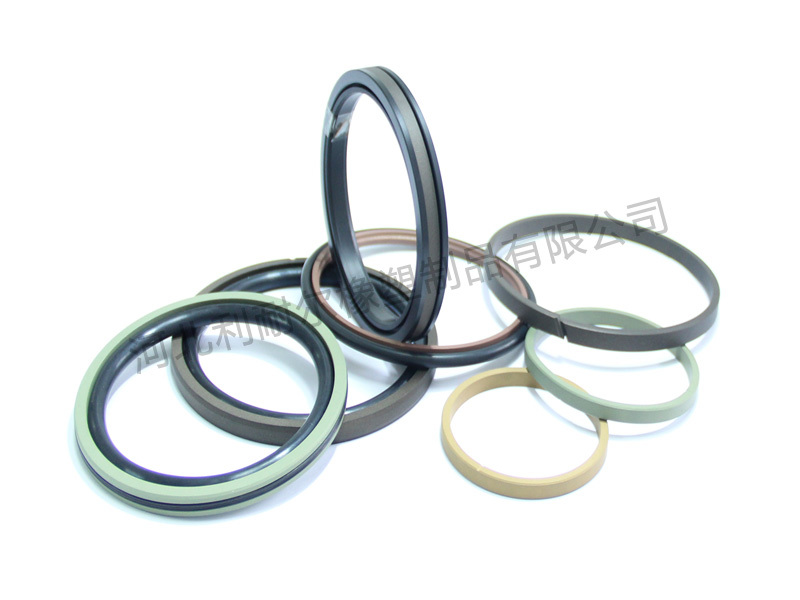
The main types of hydraulic seals are the rod seal, piston seal, wiper seal, O-ring seal, U-cup seal, and hydraulic packing set, supported by guide rings and backup rings. Each occupies a specific groove and carries a specific job.
Rod seals and piston seals
A rod seal sits in the cylinder head gland and seals against the moving rod. It faces the toughest job, because the rod carries oil outward and dirt inward. Common choices are single-lip U-cup profiles, step seals (a PTFE slipper ring energized by an elastomer), and buffer seals that absorb pressure spikes upstream of the primary seal. A piston seal sits on the piston and seals against the bore. Single-acting lip types handle pressure from one direction. Double-acting types, such as a PTFE cap seal energized by an O-ring, handle pressure from both sides.
Wiper seals, O-rings, and U-cups
A wiper seal, also called a scraper, mounts on the outer edge of the gland, and its lip is commonly polyurethane. An O-ring seal is a torus-shaped elastomer ring and the most widely used static seal; it also serves as the energizer beneath many PTFE profiles. Standard sizes follow the dash-number system in SAE AS568 in North America and ISO 3601 internationally. A U-cup seal has a lip cross-section that opens toward pressure, so fluid pushes the lips outward against the metal and sealing force rises with pressure.
Hydraulic packing and hydraulic seal kits
Hydraulic packing is an older term that is still common. It refers to sealing sets, often V-rings or chevron stacks compressed by an adjustable gland follower, used on rams and presses. Modern cylinders rely more on profiled seals, but packing remains in heavy-duty and repair work. A hydraulic seal kit bundles the parts for a particular cylinder: typically a rod seal, piston seal, wiper seal, O-rings, backup rings, and sometimes wear rings. Kits save time. Still, a kit is only as good as its match to your bore, rod diameter, and groove dimensions.

| Seal type | Typical location | Primary function | Motion |
|---|---|---|---|
| Rod seal | Cylinder head gland | Retains fluid along the rod | Dynamic, reciprocating |
| Piston seal | Piston outer diameter | Separates the two chambers | Dynamic, reciprocating |
| Wiper seal | Outer face of gland | Excludes dirt and moisture | Dynamic |
| O-ring seal | End caps, flanges, grooves | Static sealing, energizing | Mostly static |
| U-cup seal | Rod or piston groove | Pressure-energized lip sealing | Dynamic |
| Hydraulic packing | Gland or stuffing box | Adjustable sealing for rams | Dynamic |
| Backup ring | Beside O-ring or U-cup | Prevents extrusion | Static support |
How does a hydraulic seal work under pressure?
A hydraulic seal works by combining mechanical preload from installation with fluid pressure that pushes the sealing lip tighter against the mating surface. The harder the system pushes, the harder the seal pushes back, up to the limits of its material and clearance.
How does pressure energize a seal?
At zero pressure, the seal depends entirely on installation squeeze. Common design guidance puts O-ring compression at roughly 8 to 16 percent for dynamic grooves and 15 to 30 percent for static ones. As pressure rises, fluid acts on the seal's flank and forces the lip or ring into tighter contact. This self-energizing action explains why a U-cup seal often performs better at 3,000 psi than at 30 psi, and why low-pressure weeping is a classic complaint with stiff profiles. PTFE designs solve the problem differently: an elastomer energizer supplies the low-pressure preload, while system pressure takes over as it climbs.
Why do clearance gaps and extrusion matter?
Pressure also tries to squeeze the seal itself into the gap between metal parts. This is extrusion, and it works much like toothpaste escaping a tube. Soft material in a wide gap at high pressure will nibble away at its trailing edge until the seal fails. The remedies are harder materials, backup rings, and tighter tolerances. Since pressure spikes in real machines often exceed the nominal working pressure, designers typically check extrusion limits against the peak rather than the average. Of course, there are exceptions: in very low-pressure circuits, gap control is far less critical and softer, more compliant seals work well.
What role does surface finish play?
The rod and bore are part of the seal system. A commonly cited target for dynamic rod surfaces is about 8 to 16 microinches Ra (roughly 0.2 to 0.4 micrometers). Too rough and it abrades the lip; too smooth and it cannot hold an oil film, so the seal runs dry and chatters. Plating hardness, concentricity, and lead-in chamfers all affect life as well. Why do some brand-new seals fail in weeks? Often a scratched rod or sharp groove edge is the answer, not the seal.
Which materials suit a hydraulic seal?
Seal material must match the fluid, temperature, pressure, and motion type. The most common choices are NBR, polyurethane, FKM, EPDM, and PTFE compounds, each with clear strengths and limits. Good hydraulic seal material compatibility is the single most controllable factor in seal life.
Polyurethane hydraulic seals
Polyurethane hydraulic seals are favored for dynamic rod, piston, and wiper duty because of their abrasion and extrusion resistance. Typical hardness runs around 90 to 95 Shore A, which resists gap extrusion better than softer rubber. The limits are heat and moisture: standard grades generally top out near 200°F, and some are vulnerable to hydrolysis in hot, water-containing fluids. In hot-climate mobile equipment, that limit deserves attention.
PTFE hydraulic seals
PTFE hydraulic seals offer very low friction, wide chemical resistance, and a broad temperature window, and they avoid stick-slip at low speeds. PTFE is not elastic, so it normally pairs with an elastomer energizer. Filled grades, using bronze, glass, or carbon, improve wear and creep resistance. The trade-offs are cold flow under sustained load, a greater need for fine surface finishes, and more delicate installation, since some profiles must be resized after stretching over a piston.
| Material | Approx. temperature range | Strengths | Limitations |
|---|---|---|---|
| NBR | −40°F to 230°F | Mineral oil resistance, low cost, good O-ring performance | Poor with phosphate esters and ozone |
| Polyurethane | −30°F to 200°F | Abrasion and extrusion resistance | Hydrolysis in hot water-based fluids |
| FKM | −15°F to 400°F | Heat and chemical resistance | Stiff in cold; higher cost |
| EPDM | −65°F to 250°F | Phosphate ester fluids, water, steam | Swells in mineral oil |
| PTFE (filled) | −300°F to 500°F | Low friction, broad chemical resistance | Cold flow, needs energizer |
Ranges are indicative values for standard compounds. Always confirm limits on the specific compound datasheet.
How do you verify hydraulic seal material compatibility?
Start with the fluid. Mineral oil and water-glycol suit NBR in most cases. Phosphate ester fluids generally call for FKM or EPDM, and NBR generally does not survive them. Biodegradable ester fluids vary by formulation, so check with the fluid maker. Next, list the highest and lowest operating temperatures, including startup in winter and peak heat near the load. Then consider additives, because anti-wear and detergent packages can attack some compounds. Compatibility charts are a starting point rather than a guarantee, and a small immersion test, measuring swell and hardness change after exposure, is cheap insurance on unfamiliar fluids. The same logic applies to rubber diaphragms and O-rings used in accumulators, valves, and pumps.
How do you select, diagnose, and replace a hydraulic seal?
Select a hydraulic seal by measuring bore, rod, and groove dimensions, then matching profile, material, and pressure rating to the duty. Diagnose leaks by noting where and how the oil appears. Replace only after fixing the root cause. Skipping that last step is the most common reason a fresh seal fails early.
What causes a hydraulic cylinder seal leak?
A hydraulic cylinder seal leak usually traces to wear, damage, contamination, heat, or fluid incompatibility. The pattern of the leak is a useful clue, so read it before ordering parts.
| Symptom | Likely cause | What to check |
|---|---|---|
| Oil dripping from rod at gland | Worn rod seal or scored rod | Rod finish, lip wear, wiper condition |
| Wiper packed with mud and oil | Failed wiper seal | Lip hardening, fit in gland |
| Drift with no external leak | Piston seal bypass | Bore scoring, seal wear |
| Nibbled or spiral-cut edges | Extrusion or installation damage | Gap size, backup rings, thread edges |
| Hard, cracked, flat-spotted O-ring seal | Heat, compression set, or fluid mismatch | Operating temperature, compound choice |
Most premature seal failures are system problems, not seal problems. Replacing a seal without correcting contamination, heat, misalignment, or fluid mismatch simply resets the clock. This is common fluid power maintenance guidance.
How do you do hydraulic seal replacement step by step?
Hydraulic seal replacement is straightforward when done in a clean, methodical sequence. The procedure below applies to most standard cylinders, though always follow the equipment manual for torque values and special tools.
- Depressurize the circuit, lock out the power source, and relieve any trapped pressure.
- Clean the cylinder exterior, then disassemble the gland and withdraw the rod, catching the oil.
- Remove old seals with plastic or brass picks so the grooves are not scratched, and keep them for comparison.
- Inspect the rod, bore, and grooves for scoring, pitting, and burrs, and repair or replace damaged parts.
- Match the new hydraulic seal kit to the old parts by profile, dimensions, and material, and lubricate with system-compatible fluid.
- Install using proper tools and sleeves to protect lips from threads and sharp edges, avoiding twisted O-rings.
- Reassemble to specification, cycle slowly at low pressure to purge air, and check for leaks before returning to full load.
One caution: if the rod is deeply scored, new seals will not save you. Budget for rod regrinding and replating, or replacement, in the same job. For 2026 maintenance planning, many teams also log each replacement with date, compound, and operating hours so the next interval is based on evidence rather than guesswork.
How do you match sizes and avoid ordering the wrong part?
Measure rod diameter, bore diameter, and groove width and depth with calipers, then record pressure, temperature, and fluid. For an O-ring seal, measure inside diameter and cross-section and compare against AS568 or metric charts. Photograph the old seal in its groove so orientation is clear. Why do so many orders go wrong? Because inch and metric cylinders often look alike and differ by fractions of a millimeter. Ask suppliers for dimensional drawings and compound datasheets. Purchasing engineers can also request hardness and tensile test records, which help confirm that the batch matches the specification. Suppliers that run their own vulcanizing and inspection equipment can typically provide that traceability. In the end, the cheapest seal is rarely the cheapest repair, since a wrong part means a second teardown and more downtime.
Frequently asked questions
Q: How long does a hydraulic seal last?
A: There is no fixed number. Life depends on pressure, temperature, speed, fluid cleanliness, and rod finish. Well-filtered systems with correct materials often run for years, while contaminated or overheated systems may need replacement within months. Inspect at scheduled intervals.
Q: Can I reuse old hydraulic seals?
A: Reusing is not recommended. Removed seals typically have compression set, micro-cuts, or lip wear that are hard to see. Since the seals cost far less than the labor to reopen a cylinder, replace them whenever the cylinder is disassembled.
Q: What is the difference between an O-ring and a U-cup seal?
A: An O-ring has a round cross-section and suits static grooves or energizing roles. A U-cup has a lipped profile that opens toward pressure, giving dynamic sealing that strengthens as pressure rises. U-cups generally handle sliding better.
Q: Which material is best for a hydraulic seal?
A: No single material wins everywhere. Polyurethane suits abrasive dynamic duty, NBR suits mineral oil at moderate heat, FKM handles higher temperatures, and PTFE suits low friction and chemical resistance. Match the material to fluid and temperature.
A hydraulic seal looks like a small ring of polymer, but it governs leakage, pressure retention, contamination control, and machine uptime. Knowing the seal types, understanding how pressure energizes them, matching materials to fluids, and measuring carefully before ordering will prevent most repeat repairs. Treat every cylinder leak as a clue, fix the root cause, and choose parts with documented materials and dimensions. Done consistently, that approach keeps hydraulic equipment dependable through 2026 and beyond.
Related News


Get a Quote